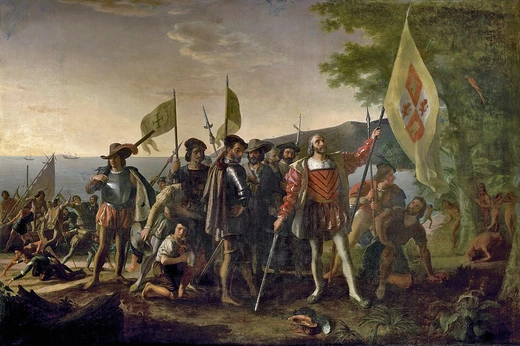
English overseas possessions

- field
- Colonial expansion
- nationality
- English
- known_for
- First overseas settlements in Ireland, then North America and the West Indies; trading posts in Asia
Lore & Background
Friedrich Engels observed that 'Ireland may be regarded as the first English colony.' The Lordship of Ireland was claimed for centuries by the English monarch, though English control was mostly resigned to an area known as The Pale.
Reader's Guide
The first English overseas settlements were in Ireland, where patterns of rule over a subordinated populated territory developed following the sixteenth-century Tudor conquest. These early colonies in Ireland served as a model for later ventures in North America, with many of the same West Country men—including Sir Humphrey Gilbert, Sir Walter Raleigh, Sir Ralph Lane, Sir Richard Grenville, and John White—involved in plantation schemes in Ireland before becoming involved in the New World. The possessions in North America, the West Indies, and Asia created networks of trade and migration that transformed England's economy and global influence. The possessions also involved conflict with indigenous populations and other European powers, particularly Spain and the Netherlands, as English colonies were established in areas already occupied by indigenous peoples and claimed by the Spanish Empire.
Did You Know?
- Friedrich Engels observed that 'Ireland may be regarded as the first English colony.'
Continental Roots and the Channel Islands
The story of English overseas possessions begins not across the Atlantic but across the Channel. The Angevin Empire represented a collection of territories spanning the British Isles and the continent. Yet the Channel Islands, surviving remnants of the Norman Duchy, maintain their connection to the Crown to this day. This long entanglement with continental territory shaped England's understanding of what it meant to hold lands beyond its own shores, laying groundwork for the overseas ambitions that would follow.
Ireland as the First Colony
Long before any English flag flew over North American soil, the island of Ireland served as the laboratory for English colonial rule. For centuries, effective English authority was confined to a narrow strip known as The Pale, while vast regions of Munster, Ulster, and Connaught remained beyond the Crown's reach. The Tudor monarchs changed this trajectory in the sixteenth century, launching plantations that transplanted Protestant settlers into the island. The Plantation of Ulster in the early 1600s brought thousands of Scottish and Northern English colonists to the province. Crucially, figures such as Sir Humphrey Gilbert, Sir Walter Raleigh, Sir Ralph Lane, Sir Richard Grenville, and John White gained their colonial experience in Ireland before turning their ambitions toward the New World, carrying with them the conviction that individual wealth and power could be amplified through overseas settlement.
The North American Arc
English ambitions in the Western Hemisphere moved from aspiration to reality over roughly a century. During Elizabeth I's reign, attempts at North American colonization proved unsuccessful. All these locations sat in territories already inhabited by indigenous peoples and claimed by the Spanish Empire, though the Spanish had not settled them. The seventeenth century saw a rapid multiplication of settlements across the Atlantic coast, including Maine, New Hampshire, Salem, Massachusetts Bay, Nova Scotia, Connecticut, New Haven, Maryland, and Rhode Island.
Asia, the Portuguese Dowry, and the Union
While the Atlantic colonies captured popular imagination, England's reach extended into the Indian Ocean and beyond through a different model: trading posts called factories. These outposts appeared in the East Indies, with Bantam as a notable example, and on the Indian subcontinent, beginning with Surat. These territories had previously belonged to Portugal, but the marriage transferred them into English hands. This episode illustrates how the English overseas possessions were built not only through military expedition and settler migration but also through the intricate web of royal alliances and territorial exchanges that characterized early modern European diplomacy.
More in Colonialism And Exploration 1-18
Spotted an error? Know more?
This is a living reference — every entry is fact-audited, and reader corrections feed straight into our audit queue. Suggest an edit · See this site's audit record